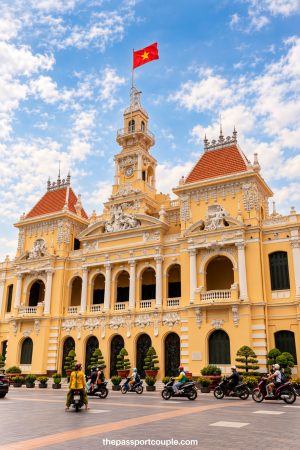
Explore the best cities in Vietnam, from Ho Chi Minh City to Hanoi! Get real tips on food, cost, safety, and travel between stops.
After two trips to Vietnam and nearly two months spent exploring the country, we’ve gotten to experience it far beyond a quick vacation. From the energy of the south to the slower pace of the north, every city has surprised us in a different way.
During our travels, we’ve dodged scooters in packed markets, discovered incredible local food, worked our way through bustling cities, and found ourselves floating past quiet rice paddies. If you’re trying to narrow down the best cities in Vietnam to visit, we’ve got you covered.
Here’s our full city-by-city breakdown, with the real details we’ve learned along the way to help you plan your own trip. Let’s get into it! 🎒

our awards:
Best for Big City Energy: Ho Chi Minh City
Best for Mekong Delta Experience: Can Tho
Best for Charm & Slow Travel: Hoi An
Best for Beaches & Day Trip Access: Da Nang
Best for “Ha Long Bay on Land”: Ninh Binh
Best for Iconic Scenery: Ha Long Bay
Best for Culture & Food: Hanoi
Best for Accessible Mountain Trekking: Sapa
Best for Adventure: Ha Giang
How We Picked These Cities
We picked this list based on culture, food, ease of travel, and variety. We didn’t want every stop to feel the same! This list roughly follows a natural south-to-north route, so it doubles as a ready-made itinerary if you’re wondering where to visit in Vietnam for the first time.
We mixed in big city stops like Ho Chi Minh City and Hanoi with laid-back river towns like Can Tho, plus a couple of adventurous add-ons (Sapa, Ha Giang) for travelers with extra time. If you’re short on days, focus on the first three or four cities. With two weeks or more, the full list makes for one of the best places to visit in Vietnam, hands down!
1. Ho Chi Minh City (Saigon)
🏙️ best for big city energy

Ho Chi Minh City, still called Saigon by many locals, is the largest and most fast paced city in the country. We think it’s one of the best places to kick off a trip in Vietnam! December through April is the dry season here, so it’s the best window for sightseeing without the worst of the rain.
We recommend staying in District 1 if it’s your first time. It’s walkable and close to almost everything! We stayed at G9 Homestay on District 1 for around $25 a night, a great budget pick if you want something central with local character. For food, don’t skip Banh Mi Huynh Hoa (a hefty, meat packed sandwich with a reputation as one of the best in the city) or a plate of com tam, the broken rice dish that’s a true Saigon classic.
From here, head to the Mekong Delta or Can Tho for a slower pace, or fly north to Da Nang and Hoi An if you’re short on time.
Grab our essentials with this FREE Vietnam Pre-Travel Checklist. Everything’s linked, so you’re trip-ready without the stress!
2. Can Tho
🚤 Best for the Mekong Delta Experience

If you want to see a totally different side of Vietnam, we recommend Can Tho as your gateway to the Mekong Delta. This is one of the best areas to visit in Vietnam if you’re after something quieter, and it’s the best base for visiting the Cai Rang Floating Market. We suggest going at sunrise (around 5 to 6 AM), when the boats are busiest, and grabbing a bowl of hu tieu noodles straight from a floating kitchen. So good! Like the south, December through April is the driest stretch here.
We recommend Green Village Mekong for an authentic homestay with a countryside feel. Breakfast and dinner are often included. For food, don’t miss grilled river fish and the Mekong’s tropical fruit, which is everywhere!
From Can Tho, loop back to Ho Chi Minh City or continue toward Hoi An.
Ever wondered what life is really like along the Mekong? Can Tho gives you a front-row seat. 🌴
3. Hoi An
🏮 Best for Charm & Slow Travel

Hoi An’s UNESCO listed Ancient Town, with its lantern lit streets and long history of tailor shops, is why so many travelers (us included!) call this their favorite stop in Vietnam. We recommend visiting February through April or September through November. Try to avoid October through December, when heavy rain brings a real risk of flooding.
Cozy Savvy Boutique Hotel was our favorite stay of the entire trip, a comfortable, well located base in town. For food, cao lau (the chewy noodle dish that can only authentically be made in Hoi An) and white rose dumplings are two dishes we think you absolutely have to try here.
Good next stop: Da Nang is a short ride away, or fly north to Hanoi.

FREE vietnam Mini Guide
Our favorite Vietnam finds: rooftop bars, hidden cafes, and epic stays from north to south.
4. Da Nang
🏖️ Best for Beaches & Day Trip Access

Da Nang pairs perfectly with Hoi An and puts you within easy reach of many of central Vietnam’s top attractions: Ba Na Hills and its Golden Bridge, the Marble Mountains, the Lady Buddha statue, and My Khe Beach. These are some of the coolest places to visit in Vietnam if you like a mix of nature and beach time. The same February-to-April and September-to-November windows apply here.
If you’re planning a Ba Na Hills day trip, we recommend booking online in advance. As of 2026, standard adult entry tickets run around 970,000 VND for tourists and non-residents (that comes out to roughly $37 USD, since 1 VND is about $0.000038). The ticket includes the cable car ride, the Golden Bridge, and the French Village. We suggest arriving early, ideally before 9 AM, to beat both the crowds and the fog that can roll in later in the day.
Choose between a beachfront stay near My Khe or a more central spot, depending on whether you want beach time or easy access to the food scene, which leans heavily into fresh, central Vietnamese seafood.
Good next stop: pair this easily with Hoi An, or fly north to Hanoi.
5. Ninh Binh
🌾 Best for "Ha Long Bay on Land"

Photo courtesy of GetYourGuide
Ninh Binh gets its nickname for good reason! Karst peaks rise dramatically above the rice paddies here, especially around Tam Coc. We recommend the Trang An boat ride through limestone caves and emerald rivers, plus a stop at Bai Dinh Pagoda, Vietnam’s largest Buddhist complex. October through April lines up with Hanoi’s dry season and is the best time to visit.
Most travelers do Ninh Binh as a day trip from Hanoi, but an overnight stay is worth it if you can swing it. The pace slows down considerably once the day trippers leave! Expect simple, countryside style food here rather than a big restaurant scene.
Good next stop: back to Hanoi, or continue on to Ha Long Bay.
6. Ha Long Bay
⛰️ Best for Iconic Scenery

Photo courtesy of GetYourGuide
Ha Long Bay’s limestone karsts and emerald water are what most people picture when they think of Vietnam, and we think it earns its spot on any list of the best locations in Vietnam, even though it’s technically a bay, not a city! October through April tends to bring clearer skies, though the bay is doable year-round.
We recommend booking a day cruise or, if you have the time, an overnight cruise, since your cabin doubles as your accommodation and most cruises include meals. Book ahead through a reputable operator, especially in peak season.
Good next stop: back to Hanoi to continue north or wrap up your trip.
7. Hanoi
🍜 Best for Culture & Food

Hanoi is Vietnam’s capital, and we think it might be the best city in Vietnam for food and culture combined. Wander the Old Quarter, grab a seat by Hoan Kiem Lake, and catch a traditional water puppet show, a performance style that dates back centuries to the rice fields of the north. October through April is the best window here, too, cooler and drier than the summer months.
We stayed at Bi Eco Suites Hanoi, an eco-conscious, budget-friendly option in a central location. Hanoi is widely known as the home of pho and egg coffee, but bun cha deserves a spot on your must-eat list too. The grilled pork and noodle specialty became a global talking point after Anthony Bourdain and President Barack Obama shared the dish in Hanoi in 2016.
Good next stop: with extra time, head further north to Sapa or Ha Giang!

Vietnam Travel Map (Google Maps)
Find our favorite spots to stay, eat, and explore, all pinned and ready for your trip.
8. Sapa
🏔️ Best for Accessible Mountain Trekking

Photo courtesy of GetYourGuide
For travelers who want mountain scenery without a major expedition, we recommend Sapa. It’s known for its rice terrace treks and visits to Hmong, Dao, and Tay ethnic villages. September to November and March to May are the best windows. Bring warm layers no matter when you go, since the mountain climate is a whole different game from the coast.
Book a homestay for either a one-day trek or a multi-day option if you want more time in the villages. The food here leans heartier than in the lowlands; think mountain vegetables and grilled meats.
Good next stop: back to Hanoi or head to Ha Giang to continue your trip.
9. Ha Giang
🏍️ Best for Adventure & Off-the-Beaten-Path Scenery

Photo courtesy of GetYourGuide
If you’re after something more adventurous, we recommend Ha Giang and its famous multi-day loop past Ma Pi Leng Pass and the Dong Van Karst Plateau. This one wasn’t actually on our itinerary, but it keeps coming up as a must-do, and honestly, the hype seems well deserved! This is by far the most remote stop on this list, and it’s the one exception to easy intercity transport: there’s no train or flight, only bus and motorbike.
We recommend booking an “easy rider” tour if you’re not an experienced motorbike rider yourself. You’ll ride on the back while a local guide handles the driving! A typical 3-day, 2-night easy rider tour runs around $180, compared to roughly $128 for self-drive. One thing to add to your checklist for 2026: foreign travelers need a border permit for the Ha Giang Loop, and anyone planning to self-drive should make sure they meet Vietnam’s driving license requirements. Homestays along the route serve simple, home-cooked mountain fare, and it’s part of the fun!
Good next stop: loop back to Hanoi to fly home or continue your trip elsewhere.
Make your trip unforgettable. These are our go-to Favorite Vietnam Activities, from street food tours to Ha Long Bay cruises, all tried and loved by us.
Getting Between Cities in Vietnam ✈️
Most of the cities on this list are easily connected by domestic flight, train, or sleeper bus, with Ha Giang being the exception noted above. Decide your route first, then pick the transport option that fits your budget and time.

Domestic Flights
VietJet, Bamboo Airways, and Vietnam Airlines connect the major cities cheaply and quickly, generally $20 to $60 one way if you book early. Baggage fees can add up on budget carriers, so factor that in.
Reunification Express Trains
The Reunification Express runs the full Hanoi-to-Ho Chi Minh City route (roughly 30 hours), with stops in Ninh Binh, Hue, and Da Nang along the way. We suggest booking overnight trains when possible, since you save on an overnight’s accommodation. Soft seats run about $10 to $15 per person, soft sleepers $35 to $55, and private two-berth sleepers around $100.
Sleeper Buses
Sleeper buses are a common budget option for routes such as Hanoi to Sapa or Ho Chi Minh City to Can Tho, typically costing $8 to $20 depending on the distance. Bring a layer; the AC on these buses runs cold!
From north to south, this Vietnam Travel Guide helps you plan it all.
Budgeting Across Vietnam's Best Cities 💸

Vietnam is genuinely affordable across the board, though costs are a bit higher in Ho Chi Minh City and Hanoi than in the Mekong Delta, Hoi An, or Ha Giang. Based on our own 14-day trip, we averaged $44 per person per day, and we think that’s a realistic mid-range benchmark for most travelers.
Quick tip: exchange rates fluctuate, but as a rough guide, 1 VND is worth about $0.000038 USD, so 1,000,000 VND is roughly $38.
Daily Budget by Style
- Backpacker: $25 to $40/day
- Mid-range: $50 to $80/day
- Comfortable: $100+/day
Cash vs. Card
We recommend carrying cash everywhere you go, since most places outside upscale restaurants and hotels don’t take cards. This matters even more in rural stops like Ninh Binh and Ha Giang, where ATMs can be harder to find once you’re off the main road.

Free vietnam pre-travel checklist
Save yourself the stress: grab this free pre-travel checklist with all the right links ready to go.
Packing List for a Vietnam City Hopping Trip 🧳

We recommend packing light, breathable clothing since it’s hot and humid across most of the country, plus a rain jacket and something modest for temple visits (covered knees and shoulders). Slip-on shoes make temple and homestay visits way easier since you’ll be taking them off constantly! Laundry is cheap and easy nearly everywhere, usually around $1-$2 per kilo, with delivery included.
If you’re adding Sapa or Ha Giang to your route, pack warmer layers. The mountain climate is a real departure from the heat of the south and center, especially in the early morning and evening.
Top 5 Packing Picks
- Mini handheld fan
- Portable charger
- Slip-on shoes
- Packable rain jacket
- Phone strap (a simple scam prevention tool, more on that below!)
Pack smarter, not harder. We’ve rounded up everything we actually used in Vietnam Packing List, from comfy travel outfits to must-have gadgets, so you’re ready for any adventure.
Is It Safe to Visit These Cities? 🛡️

We never felt unsafe in Vietnam, but stay alert, especially in busier tourist areas. Save these numbers before you go:
- Police: 113
- Ambulance: 115
- Fire: 114
We also recommend registering your trip with the U.S. State Department’s free travel enrollment program before you go. It only takes about five minutes and gives you real-time alerts if something serious happens while you’re there.
Travel Insurance
We suggest a solid travel insurance policy that covers accidents, especially if you’re planning to ride any part of the Ha Giang Loop yourself.
Top Scams to Know
Phone snatching from moving motorbikes is a real risk, especially with your phone out in traffic, so a phone strap really helps. Rigged metered taxis are another common issue, which is why we recommend sticking to the Grab app instead of hailing a cab on the street. Watch for the fruit basket scam, too, where a vendor places a basket on your shoulders for photos and then demands payment. A polite decline usually ends it!
Don’t forget to get our go-to travel insurance for every trip to cover medical emergencies, cancellations, and even lost luggage!
Wrapping Up the Best Cities in Vietnam 🙌

Vietnam rewards travelers who are willing to move around, and this list of the best cities in Vietnam gives you a route that flows naturally from south to north, whether you have one week or a full month to spend. Start with Ho Chi Minh City and the Mekong Delta, work your way through Hoi An and Da Nang, and finish in Hanoi with an optional detour north to Sapa or Ha Giang if you’re up for an adventure!
FAQ for Visiting Vietnam's Best Cities
What are the top 3 cities in Vietnam to visit?
If you only have time for three, we recommend Ho Chi Minh City, Hoi An, and Hanoi. Together, they cover Vietnam’s biggest city, its most charming small town, and its cultural capital.
Where should first-time visitors go in Vietnam?
For a first trip, we suggest starting in Ho Chi Minh City and working north through Hoi An and Da Nang before finishing in Hanoi. This route hits the most iconic stops without any backtracking.
What is the best city in Vietnam to live in?
That depends on lifestyle, but Da Nang and Hanoi both come up often for expats. Da Nang for its beaches and lower cost of living, Hanoi for its culture and food scene. This is worth researching further if long-term living is your goal, since visa rules and the cost of living can shift.
How many days do you need to see the best cities in Vietnam?
We recommend a minimum of 7 days for a shortened version of this route, and 12 to 14 days if you want to comfortably fit in Ho Chi Minh City, the Mekong Delta, Hoi An, and Hanoi with a couple of day trips.
Do I need a visa to visit these cities?
Most travelers will need a Vietnam e-visa. As of 2026, it costs $25 for a single-entry e-visa or $50 for a multiple-entry e-visa, valid for up to 90 days. We recommend applying at least a week or two before your trip to leave room for processing.
Is it easy to travel between these cities?
Yes! Domestic flights, trains, and sleeper buses connect nearly every city on this list. Ha Giang is the one exception, since it’s only reachable by bus and motorbike.